The theory of binary oppositions was created by Levi Strauss. They are pairs of concepts that are opposite to each other in meaning.
Examples include: good vs evil, love vs hate, dark vs light etc. These words act as symbols for society's ideas and meanings of the words.
Wednesday, 24 October 2012

Tuesday, 23 October 2012
Focus Task.
In today's task we used DSLR cameras to learn as well as practice the functions of manually focusing within shots. We had to show narrow depth of field, this involves having the background of the shot blurred and the foreground in sharp focus.
We also learnt about changing the F stop, this changes the distance of the focus. The smaller the F stop number, the deeper the focus will. And visa versa.
Below is a video that shows my group and I practising this technique:
Monday, 22 October 2012
Recce.
We went down an abandoned underground section of Achland Burghley School. It is strictly off limits to students but it is ideal for our horror trailers. I has no stable flooring and there was rubbish everywhere. When we were down there we all felt a bit uneasy and slightly scared due to its emptiness and isolation. Location is very important within the film industry as it can set the whole scene/ prepare us for what may happen next.
*ADD PHOTOS
*ADD PHOTOS
Thursday, 18 October 2012
Permission Letter.
In order to incorporate our chosen songs into our trailers, we had to write letters asking for permission to use the songs due to copyright.
*PRINT SCREEN OF LETTER
*PRINT SCREEN OF LETTER
Monday, 15 October 2012
Representation Theory.
The media represents the world to us. They show us how things actually are as well as how they should be. The main representations we study in media studies include:


- Femininity
- Masculinity
- Sexuality
- Social Class
- Race and Ethnicity
- National Identity
- Age
Hegemonic Cultural Stereotyping
This theory suggests that the media reinforces and circulates traditional and old fashioned representations. They then represent them to audiences as common sense eg. men and woman should behave in a certain way.
Masculinity - Eg. Bruce Willis in Die Hard. He's muscular, saves those in trouble, tough, good guy fighting evil.
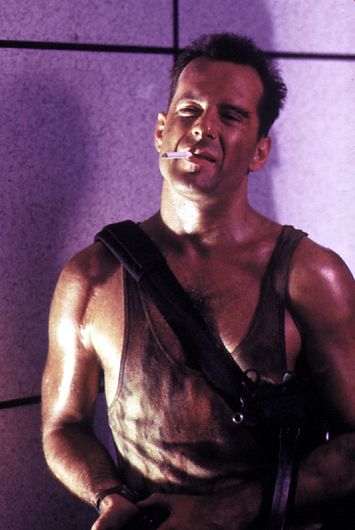
Femininity - Mary Jane in Spiderman. Weak character that needs to be rescued as she is in danger.

Sexuality - Graham Norton. Very camp television presenter.

Race and Ethnicity - Ali G (exaggerated Asian stereotype)

Age - Grandad in Only Fools and Horses.

National Identity - West is West. Father takes son to Pakistan as he feels he has lost connection with his culture.

Social Class - Hugh Grant as the middle class twit in Notting Hill.
Although these are characters we enjoy to watch, hegemonic stereotyping can lead to passive consumption. Eg. Young boys thinking they should act like Bruce Willis.
Thursday, 11 October 2012
Mulvey's "Male Gaze" Theory.
Laura Mulvey believed that some women were represented in films in a way that will draw male attention. Woman are forced to view things through the eyes of a man. It is a feministic view of voyeurism. The cameras linger the bodies of females, this shows off women as sexual objects to gratify men. However, there have been changed towards the representation of women over the past few years. For example Kill Bill Vol 2.
Wednesday, 10 October 2012
Stock Characters in Horrors.
The stock characters are the people who make the film fun and entertaining. We are surrounded by stock characters in real life, that we automatically recognise them and their characteristics as soon as they appear on screen. Although predictable, they are they ones we look forward to seeing the most.
Subscribe to:
Posts (Atom)